Bad Logic at Three in the Morning
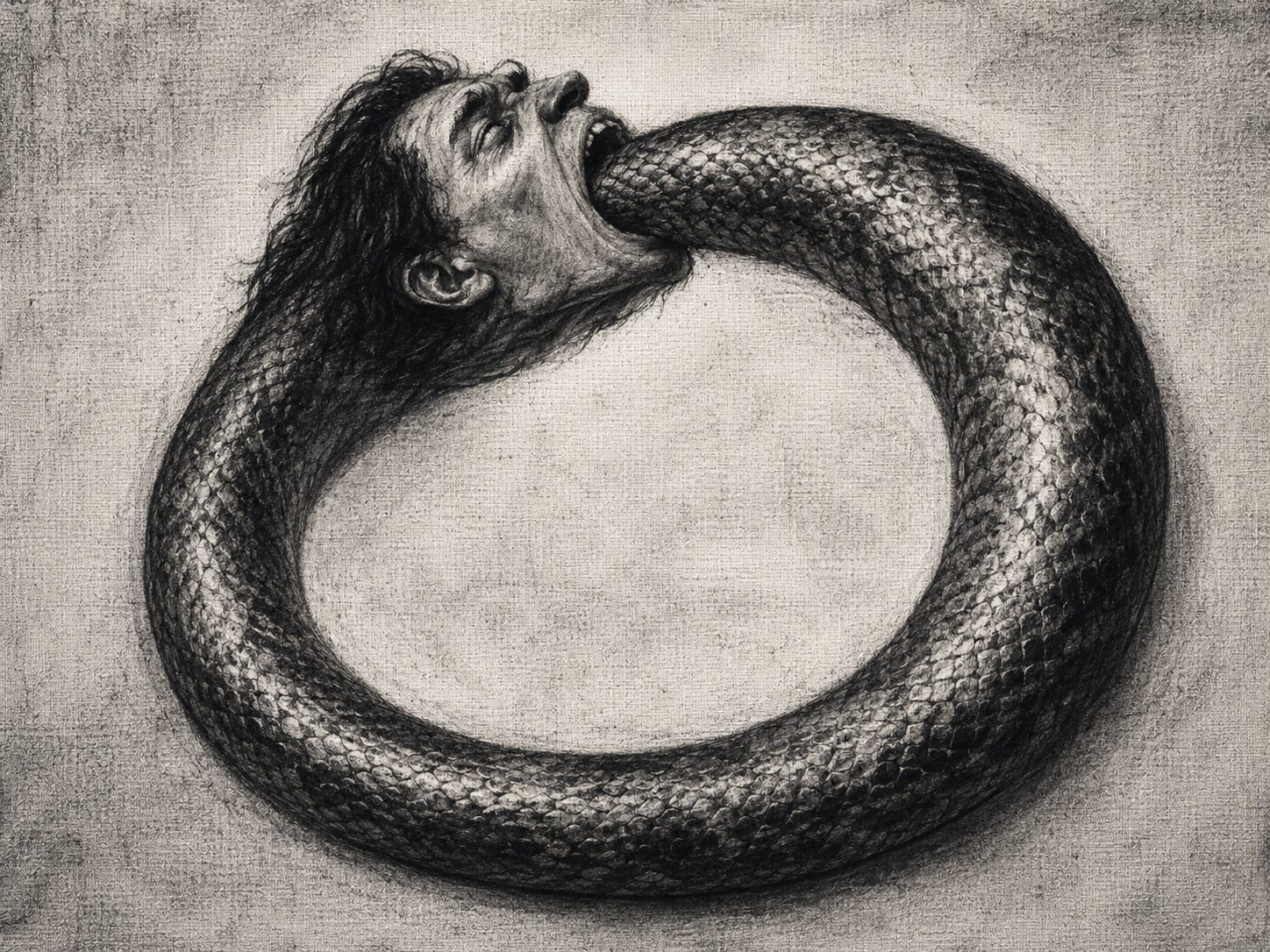
Acronyms and terms used in this post:
RNT: Repetitive Negative Thinking, the mental habit of returning again and again to the same painful thought, not because it is useful, but because the mind cannot stop chewing it.
CBT: Cognitive Behavioral Therapy, a practical form of therapy that studies how thoughts, feelings, and actions keep reinforcing one another.
Depression does not always enter the room like tragedy. Sometimes it enters like a badly trained lawyer.
It does not say, “You are sad today.” That would be too honest. It says, “You are sad today because your whole life has been a clerical error.” Then anxiety comes in with a plastic file, loneliness brings the tea, and together they conduct a full inquiry into why you are permanently defective.
At three in the morning, this feels like philosophy.
By breakfast, if breakfast happens, it looks more like bad grammar.
I am beginning to suspect that a large part of my suffering is not only emotional. It is linguistic. The sentences themselves go rotten. The mind takes a small fact, coats it in fear, fries it in shame, and serves it as destiny. In Calcutta we know this method. Many things here are sold after excessive frying.
Here is one of the mind’s favorite dishes: tautology.
“I am alone because nobody wants me.”
Then, without shame, the same sentence returns wearing the reverse shirt.
“Nobody wants me because I am alone.”
This is not thinking. This is a ceiling fan going round and round during a power cut in your imagination. It makes motion. It makes noise. It cools nothing.
A tautology is a statement that proves itself by repeating itself. In ordinary life it is harmless enough. “It is what it is.” “Boys will be boys.” “Politics is politics.” These phrases are the linguistic equivalent of an uncle leaning back after lunch and contributing nothing to civilization. But inside a depressed mind, tautology becomes dangerous because it shuts the door from the inside.
“I failed because I am a failure.”
Wonderful. Very neat. Also useless.
Where is the evidence? What exactly failed? Which part? When? Under what condition? Was it money? health? opportunity? timing? illness? bad luck? bad judgment? inherited family circus? economic rot? Calcutta humidity? All of the above, arranged like vegetables in a sad municipal market?
The tautological mind does not care. It likes round answers. Round answers roll easily in the skull.
And then there are metaphors.
Metaphors are supposed to help. They are little hand-pulled rickshaws for heavy ideas. If I say depression is a fog, you immediately understand that things become unclear, nearby objects lose their edges, and the future disappears after twenty feet. Good metaphor. Useful metaphor. Keep it. Give it tea.
But a metaphor can become a landlord.
“I am sinking.”
Am I? Literally? No. There is no water in the room, except perhaps in a plastic bottle beside the bed and some suspicious dampness on the wall that the landlord will blame on “weather.” What I mean is: I am frightened about money, work, age, health, and the slow shrinking of my social world.
But “I am sinking” does something else. It tells the body to panic. It tells the chest to tighten. It tells the brain to start looking for a shipwreck. Soon I am not a man with a consulting problem. I am the Titanic, but without the orchestra and with worse dental work.
Metaphor has slipped from servant to tyrant.
This happens quietly. “Life is a race” becomes “I am behind.” “Marriage is success” becomes “I am defective.” “Career is identity” becomes “I am finished.” “Family is shelter” becomes “I am exposed.” “Money is oxygen” becomes “I am suffocating.” Some of these phrases contain truth, but not enough truth to be allowed to run the government of the mind.
A metaphor should be a torch. It should show you where the furniture is. It should not burn down the house.
Then comes the straw man.
This one is especially common in loneliness. You sit alone in a rented flat, somewhere in the half-forgotten edge of the city where the main road has ambition but the lanes still look apologetic. A scooter coughs outside. A pressure cooker whistles in someone else’s kitchen. Somewhere a television anchor is shouting as if India’s destiny depends on his blood pressure.
You, meanwhile, have not spoken to a human being properly all day.
So the mind invents humans.
Not kind ones, naturally. That would be too generous. It creates a committee. Former classmates. Relatives. Old colleagues. Neighbors. Successful people with clean shirts. The whole invisible Bengali jury, sitting under a fan, examining your life with the tenderness of a tax notice.
“They all think I am finished.”
Do they?
Did they say so?
When?
In what words?
The mind waves away these vulgar demands for evidence. It knows. It has sources. It has WhatsApp University with direct access to your shame.
This is a straw man argument: inventing an opponent, giving him a cruel speech, then reacting as if the speech came from the real world. In politics, it produces shouting. In loneliness, it produces withdrawal. You stop calling people because you already know what they think. But you do not know. You guessed. Then you suffered from the guess as if it were a court judgment.
This is how loneliness grows its own walls.
First, you feel ashamed. Then you hide. Because you hide, nobody sees the whole of you. Because nobody sees the whole of you, your imagination fills in their opinion. Because the opinion is imagined during depression, it comes out poisonous. Then you hide more.
A fine system. Completely self-service. No subscription required.
The fourth villain is what I call concentric thinking.
It begins with one small thing.
A delayed reply.
A headache.
A bill.
A toothache at dawn.
A bank balance that looks like it was designed by a minimalist artist.
Then the first circle forms: I am tired.
Second circle: I am not functioning.
Third circle: I have failed.
Fourth circle: I am socially useless.
Fifth circle: I am biologically defective.
Sixth circle: nobody will ever understand.
Seventh circle: there was never any point.
By now the original event has disappeared. The delayed reply has become a referendum on human existence. A toothache has become a thesis on destiny. A bad Tuesday has become the whole Mahabharata, but with one character, no chariot, and unpaid broadband.
This is why rumination is so seductive. It feels like depth because it keeps going inward. But not every inward movement is insight. Sometimes it is just a drain.
The depressed mind mistakes connection for proof. Yes, the toothache is connected to sleep. Sleep is connected to mood. Mood is connected to work. Work is connected to money. Money is connected to status. Status is connected to loneliness. Loneliness is connected to childhood. Childhood is connected to memory. Memory is connected to identity. Identity is connected to mortality.
Fine. Everything is connected if you pull hard enough. That does not mean every small pain is allowed to become a national emergency.
This is the important part.
Some suffering is real.
This must be said clearly, because otherwise we enter the smug territory of “change your thoughts, change your life,” which is often said by people whose lives appear to contain protein, sunlight, and family property. Poverty is not a thought distortion. Bipolar depression is not a decorative mood. Anxiety is not solved by buying a nicer notebook. Loneliness in middle age is not a motivational quote waiting for font selection.
Some doors did close.
Some people did leave.
Some chances were lost.
Some economies are cruel.
Some families cannot understand illness unless it arrives with a bandage, a prescription, and preferably a fever.
So no, the answer is not to become cheerful by editing one sentence. If life were that simple, Calcutta would have solved despair by printing better wall slogans.
But language still matters.
A bad sentence is not the whole illness, but it can become a handle by which the illness drags you around the room.
So now I try, when I have the strength, to catch the sentence before it becomes weather.
“I am ruined.”
Pause.
What is the plain version?
“I am scared about money today.”
That is still unpleasant. But it is smaller. It fits in the hand.
“Nobody wants me.”
Pause.
What is the plain version?
“I feel unwanted because I have had too little recent human contact.”
Still painful. But now it has doors. Contact can be changed, not magically, not easily, but in principle. “Nobody wants me” is a sealed tomb. “I have had too little contact” is at least a room with a reluctant window.
“They all think I am a failure.”
Pause.
Who is “they”?
Always beware of “they.” “They” is often just shame wearing a crowd mask.
“My life is over.”
Pause.
No. My mind is making a permanent claim during a temporary low.
Temporary may mean hours. It may mean weeks. In illness, temporary is not always short. But it is still different from eternal. The depressed brain is a terrible calendar maker. It takes one dark morning and schedules it through infinity.
There is a strange comedy here. I have spent years around systems, data, healthcare, America, hospitals, research, software, standards, all those large serious machines with expensive acronyms and fluorescent lighting. I have seen data pipelines break because two systems used the same word to mean different things. I have seen grown institutions fail because a label was wrong.
Then I come home, sit on a bed in Calcutta, and my own brain does the same thing.
It labels fear as prophecy.
It labels loneliness as proof.
It labels exhaustion as character.
It labels a bad month as a failed life.
This is not wisdom. This is misclassification.
The street version is simpler: the mind puts the wrong sticker on the jar. You reach for sugar and get salt. Then you blame the tea.
That is why I now distrust thoughts that arrive too polished. The worst ones often sound literary. “I was always meant to be alone.” Beautiful sentence. Very poisonous. It has rhythm, shadow, finality. It could sit nicely at the end of a serious novel where people stare at rain.
But life is not a serious novel. Life is a damp towel, a missed call, a kettle that takes too long, a mosquito with military training, and a man trying to decide whether brushing his teeth counts as progress.
Some days it does.
The mind wants a grand verdict. Give it a smaller job.
Not: What is the meaning of my whole life?
Try: Did I eat?
Not: Am I lovable?
Try: Did I speak to one human honestly this week?
Not: Have I failed as a man?
Try: What is the next unpaid thing, the next painful thing, the next necessary thing?
This is not inspirational. It is plumbing. But when the bathroom is flooding, philosophy can wait.
The little repair begins with language.
Catch the loop.
Trim the metaphor.
Question the imaginary jury.
Shrink the circles.
Return to the first fact.
The fact may still hurt. Let it. Pain does not need decoration. A small, accurate pain is hard enough. There is no need to give it a crown, a passport, and hereditary rights over the kingdom.
I remain what I am: a 51-year-old lower middle-class Bengali man in the Calcutta outskirts, living too much inside his head, earning uncertainly, carrying a brain that sometimes behaves like a badly wired old house during monsoon. Sparks, damp walls, mysterious noises, sudden darkness.
But even in such a house, one can learn which switch not to touch.
That may not be recovery.
It may be the first honest electrician’s note pinned near the fuse box.
P.S. References: Susan Nolen-Hoeksema’s work on rumination and depression;